
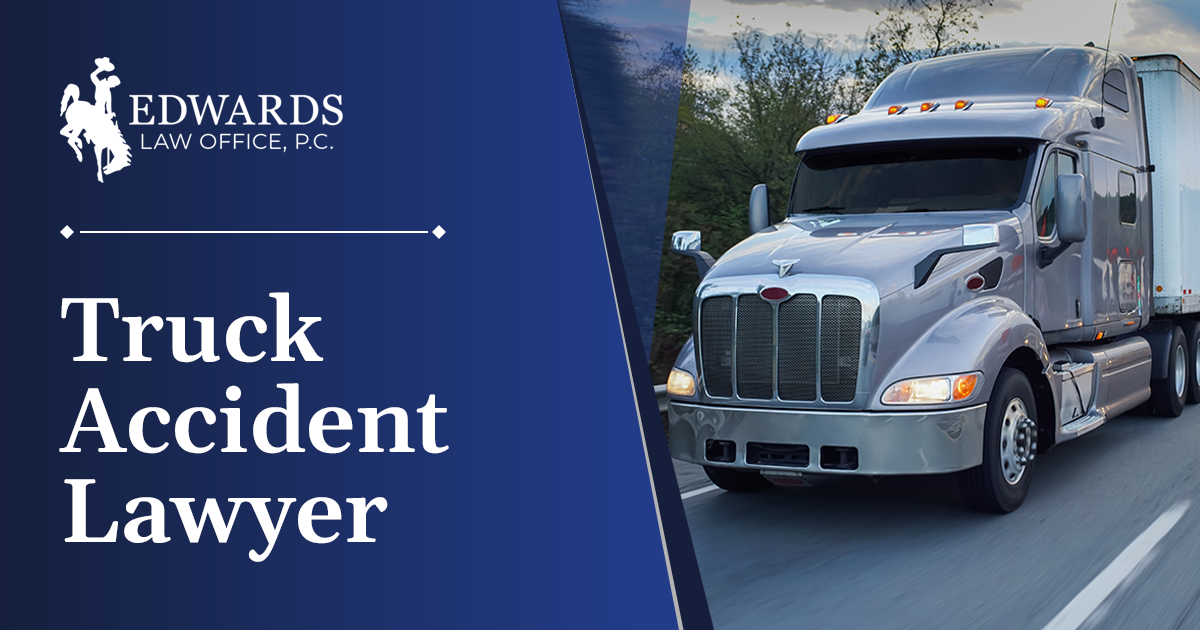
When was the last time a big rig “snuck up” on you out on I-80 or I-25? Has your car ever been shaken in the wake of an eighteen-wheeler racing past you on US-85? We can’t help sharing the road with commercial vehicles, but that doesn’t mean they won’t occasionally trigger a momentary flash of stress.
The worst-case scenario would be getting into an accident with one of those trucks. No matter how cautious a driver you might be, you can’t always compensate when a truck driver is engaging in reckless driving or their brakes give out.
When an accident does happen with a commercial vehicle, it sets off all kinds of automatic investigations. That can actually work in your favor. However, there is no guarantee that the insurance claim you file to be compensated for your losses will be stamped “approved.” That is why the best course of action after getting into an accident with a big rig is to speak to an experienced Cheyenne truck accident lawyer.
The attorneys working at Edwards Law Office, P.C. have helped many folks file personal injury claims against truck drivers and the companies they work for. With your family’s financial future at stake, you owe it to yourself to explore all your options for a remedy after being struck by a truck.
How Truck Accidents Are Different from Car Accidents
The obvious difference between a truck accident and a car accident is the level of destruction due to the massive difference in weight. A fully loaded commercial semi-truck can weigh up to 80,000 pounds, while a typical passenger car weighs 3,000 to 4,000 pounds.
There is also the braking distance to consider. A car requires 316 feet to come to a complete stop when traveling at 65 mph. A commercial truck needs 525 feet, nearly the length of two football fields. Also, a commercial air brake system has a fractional response delay compared to a passenger vehicle with a hydraulic brake system.
The high ground clearance on large trucks frequently causes smaller passenger vehicles to “underride” the trailer. That can result in disproportionately catastrophic damage to the car and severe injuries to its passengers.
There are also added levels of legal complexity with truck accidents because they must comply with strict rules from agencies like the Federal Motor Carrier Safety Administration, as well as the Wyoming Department of Transportation (WYDOT) and the Wyoming Highway Patrol.
There might also be multiple liable parties. Unlike a standard car wreck that usually involves just two individual drivers, a personal injury claim in a trucking accident can name the driver, the trucking corporation, cargo loaders, and maintenance contractors as potential at-fault parties.
These added complexities are exactly why you need the support of Edwards Law Office, P.C. We have extensive knowledge of how trucking companies operate and what tactics their insurance carriers will deploy to shift blame and reduce their exposure. We won’t back down from fighting for what is right for our clients.
Critical Evidence to Collect After a Wyoming Truck Crash
A truck accident will automatically trigger investigations with several government agencies. They are looking to see if the truck driver and the trucking company comply with the regulations. To prove negligence, you need compelling evidence. The attorneys at Edwards Law Office, P.C. have a checklist of vital evidence we help collect with every truck accident claim.
Here is the evidence that we help collect:
Photos and video: All the photos and videos you might have taken in the accident will be collected along with the photos and videos captured by other drivers and investigative agencies. These images should cover the accident from all angles and record things like skid marks, road debris, weather conditions, and your visible injuries.
- Witness contacts: If there were witnesses, we can help track them down and get them to provide an affidavit of what they saw. Memories fade. That is why it is important to get that information as quickly as possible.
- Official reports: The responding police agency will generate an accident report that will provide details of the collision and any citations issued at the scene.
- Black box (EDR/ECM): A truck’s black box will record the vehicle speed, braking actions, and engine diagnostics right before impact. That will be crucial information to prove a driver’s actions.
- Electronic logging devices (ELD): The Federal Motor Carrier Safety Administration (FMCSA) sets hours of service regulations for every commercial truck driver. Those hours must be logged by an electronic logging device. The ELD information can be checked for fatigue or illegal overtime.
- Dispatch records: These records show all the communications between the driver and trucking company. They include GPS tracking and delivery deadlines that may have forced the driver to speed to make company deadlines.
- Maintenance files: These files can reveal if brake wear or mechanical failure contributed to the crash. In those scenarios, fleet mechanics could be held liable.
- Driver history: We can look into the driver’s history, medical certifications, and prior violations.
- Post-accident tests: If the truck accident involves injuries, there are legal requirements for drug and alcohol testing. It triggers automatically if a crash results in a fatality or if the driver has been cited within eight hours for alcohol or within 32 hours for drug use. The results can prove if the driver was under the influence at the time of the accident.
This might seem like an exhaustive list, and it is. The more evidence we can collect that establishes fault, the stronger your claim will become. That can have a direct impact on your settlement.
Common Types of Injuries in Truck Accidents
Truck accidents can often result in severe, life-threatening, or even fatal injuries due to the massive force of impact. Victims may require long-term medical care or face permanent disabilities. That can create huge financial burdens for the family.
Common injuries include:
- Traumatic brain injuries from head impacts or whiplash.
- Spinal cord injuries resulting in partial or total paralysis.
- Broken bones and crush injuries.
- Internal organ damage from blunt force trauma.
- Severe burns caused by fuel fires or chemical spills.
- Psychological damage like post-traumatic stress disorder (PTSD).
Beyond the physical harm, victims of truck accidents can also experience intense emotional distress and reduced quality of life. All of that should be taken into consideration when determining the value of what you’re asking for as part of your claim.
Calculating the Full Value of Your Truck Accident Damages
The damages you ask for in your truck accident claim need to provide for your immediate and future losses. Our legal team works closely with our clients to understand the full scope of those damages. They will fall into the following categories:
Economic Damages
- Medical bills: All past and future hospital stays, surgeries, physical therapy, prescriptions, follow-up visits, and medical equipment.
- Lost wages: Any income you’ve lost while recovering from your injuries should be covered. The hope is that you’re able to return to work. If not, your reduced future earning capacity should be factored into the final amount.
- Property damage: This covers the costs of repairing or replacing your vehicle and personal items inside it.
- Out-of-pocket costs: You’re entitled to seek travel costs for medical visits or specialized home care.
Noneconomic Damages
- Pain and suffering: This covers all the physical discomfort and emotional trauma you experienced from the crash.
- Loss of consortium: If there has been a negative impact on your relationship or companionship with your spouse, that should be compensated.
- Punitive damages: Also called “exemplary damages,” these could be added if the truck driver showed gross negligence, like drunk driving or falsifying logbooks
It is important to note that Wyoming places no legal limits on economic or noneconomic damages. However, you need to be aware of the state’s comparative fault rule. You can recover money only if you are 50% or less at fault. Your total award drops by your exact share of blame.
How a Cheyenne Truck Accident Lawyer Fights for Your Claim
A truck accident claim is rarely as straightforward as a typical car accident case. The moment the accident is reported, the trucking company will dispatch their insurers and investigators with a single goal in mind: reducing or denying liability. That is why you need the same level of support. You can find that at Edwards Law Office, P.C. We move just as quickly to protect your interests.
There will be a lot of evidence under the trucking company’s control that needs to be preserved. When our legal team takes up a claim, one of the first things we’ll do is issue a spoliation letter to prevent the destruction of any data from the truck or company that relates to the accident. That includes the driver’s history and training.
Wyoming’s statute of limitations for a personal injury claim is four years from the date of the truck accident. While that may sound like plenty of time, a lot of evidence can disappear, and witness accounts can change as memories fade. It is important to file a claim when you have a complete understanding of all your potential medical costs, but that doesn’t automatically mean running out the clock.
We know how important it is to come to a resolution that will secure your finances and allow you to focus on your recovery. We want to help our clients get their lives back on track.
Throughout every stage of the process, Edwards Law Office, P.C. keeps our clients informed. No decision will be made regarding settlements unless you are in full agreement. There might also come a time when we need to move from negotiation with the insurance company to a civil lawsuit. We’ll be fully prepared to make that pivot to the courtroom. We’ll only proceed to a trial when we feel there’s an exceptionally strong case.
If you or someone you love has been injured in a commercial truck accident, don’t wait to get the answers you need to decide what should happen. Reach out to Edwards Law Office, P.C. today to schedule a free consultation to discuss your case with an experienced Cheyenne truck accident lawyer. We’re standing by to hear your story and talk about what needs to happen next.